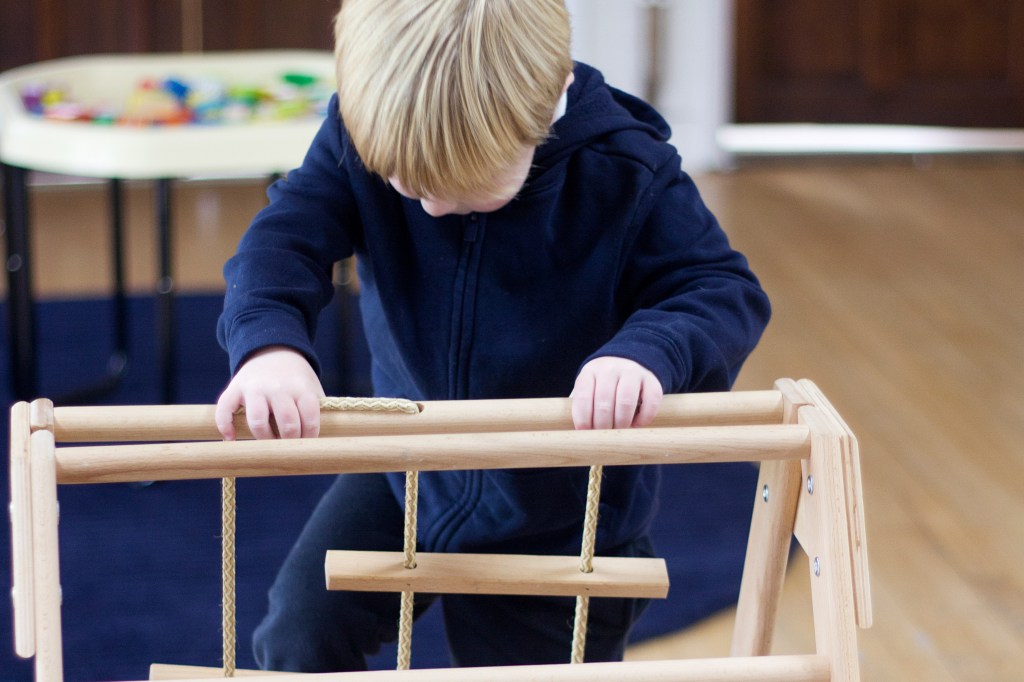
Maria Montessori was an Italian child practitioner pioneered what we know today as The Montessori approach. “Education of even a small child…does not aim at preparing him for school but life’. This child centred approach has with it the deep routed understanding that every child is a unique and dynamic learner. This approach enables each child to learn at their own pace and in their own way, consequently fostering an intrinsic love of learning and an indirect preparation of teaching children without them noticing.
At The Little Lighthouse, we feel that the Montessori approach compliments the EYFS curriculum and thus adopt many of the Montessori school of thought but not exclusively. Activities are taught and scaffolded and the children are free to repeat the activity as oft as they will during free flow with guidance or support if needed until it is mastered. The Montessori approach focuses on five key areas of learning which are explained below.
1. Practical Life
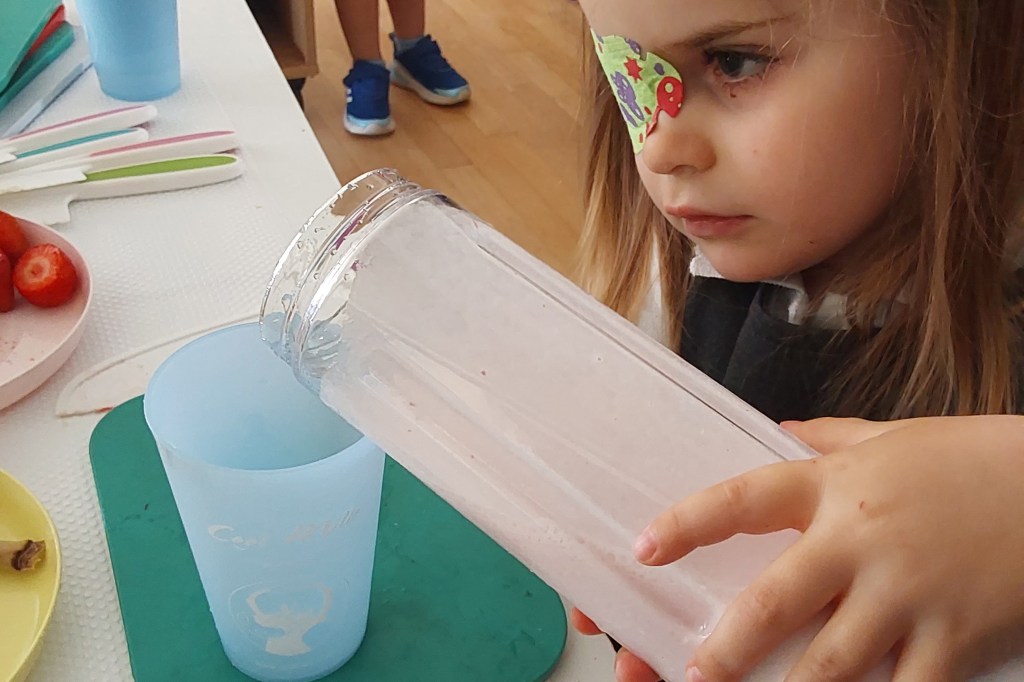
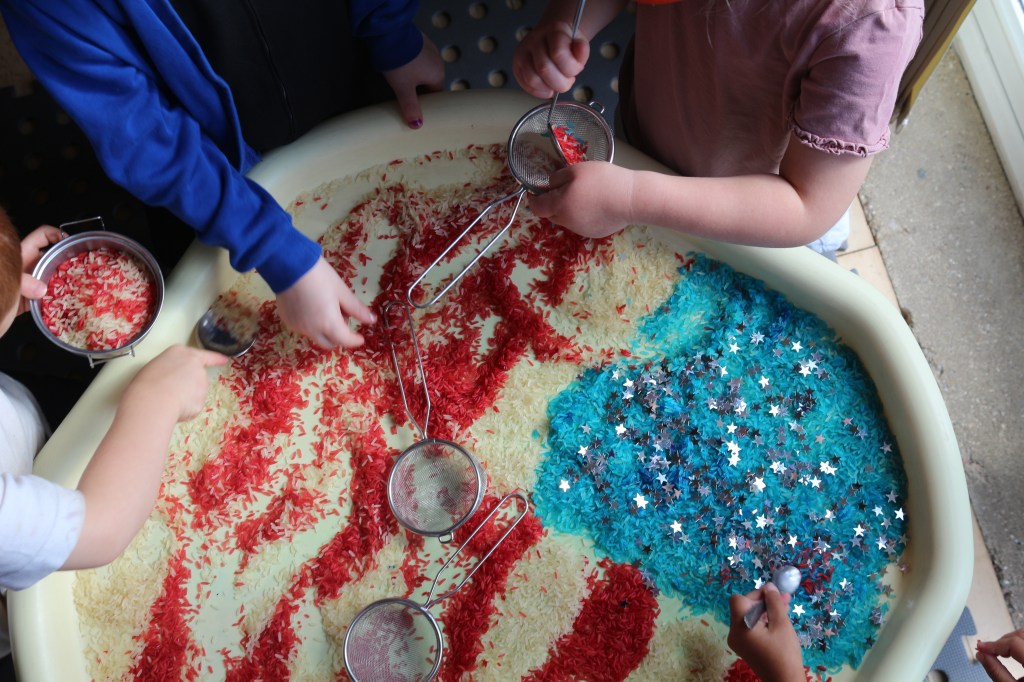
This encompasses area of development care of self, care of the environment, grace and courtesy and control and movement. Children develop a mastery of everyday tasks and develop their fine motor skills. This includes, washing dishes, polishing surfaces, cutting fruit or pouring water for snack time. The development of these skills is not only empowering but enables children to be more responsible. Prior to mastery of a task such as pouring water for snack time, children learn to pour grains or beans. This dry pouring activity serves as a precursor for pouring liquids and once a level of competence has been achieved children not only feel more empowered but is now more self-sufficient during snack times.
2. Sensorial Learning
Much of the learning that occurs is sensorial learning, which by name encompasses the the development of all five senses. Namely, the visual, tactile, olfactory, gustatory, auditory and an added sixth, Stereognostic or kinaesthetic. Tasks and activities set are tailored to enable children to begin to distinguish their surroundings and note differences in shape, texture, smell, sounds and taste. Activities that facilitate this include activities such as the colour grading tablets, which enables visual exploration. The colour grading task teaches children to sequence and differentiate a spectrum of colours, which forms a very integral part to the Montessori method.
The Binomial Cube
This is a three dimensional puzzle representing (a+b)^3) of course children perceive this task as playing whilst the undertone of this activity screams maths!
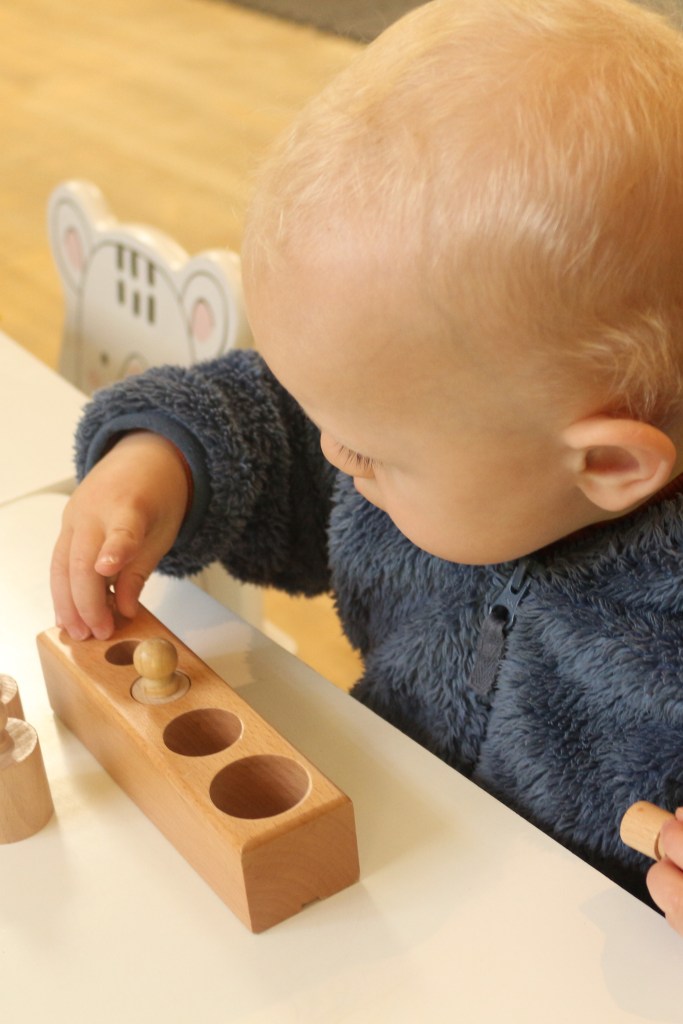
Knobbed Cylinders
This activity is a clever interplay between children’s ability to visually discriminate, which again appeals to their sensorial learning, and their self checking skills. It challenges a child’s perception of dimension and authentically builds on children’s inner resilience. Again, this activity is purely mathematical.

3. Maths
Maths is all around us! From the numbers on a bus or a front door, to the patterns of a leaf. We have purchased a number of equipment to support and encourage the development of maths. For example, the Hundred Board requires children to grasp the fundamental concept of the base ten number system. It also reinforces number sequencing to 100. Puzzles teach even the youngest amongst us about size, dimension, number, sequence and shape. The pink tower is another mathematical toy requiring a child to build a tower using a variety of blocks differing in size. The idea is to start with the biggest and end with the smallest.
The Spindle Box
This helps visualise the association between the numeral and quantity and successfully help children to understand zero. It also promotes counting.
The Small Red Rods
This is ten rods consisting of the same cross-section with lengths of 2.5cm to 25cm, which deepen children’s understanding of number.
Sandpaper Numbers
Children navigate their fingers over the formation of each number on the textured sandpaper. This enables a child to develop their muscular perception of the number as they learn the shape and sound of each digit. The multisensory attributes pertaining to this activity is perfect for children in the tactical phase of development.
Number Rods
These are essential for helping children count reliably to 10, as it provides visual cues. It also encourages mathematical language and children will begin to use words such as, ‘more’ or ‘less’ when comparing numbers. It also enables children to fathom one more or one less than a given number.
4. Language (Literacy)
Much of the sensorial and practical life activities are designed to be a subtle precursor for reading and writing. Tactile language materials such as sandpaper letters help children learn their sounds and then learn to word build and read.
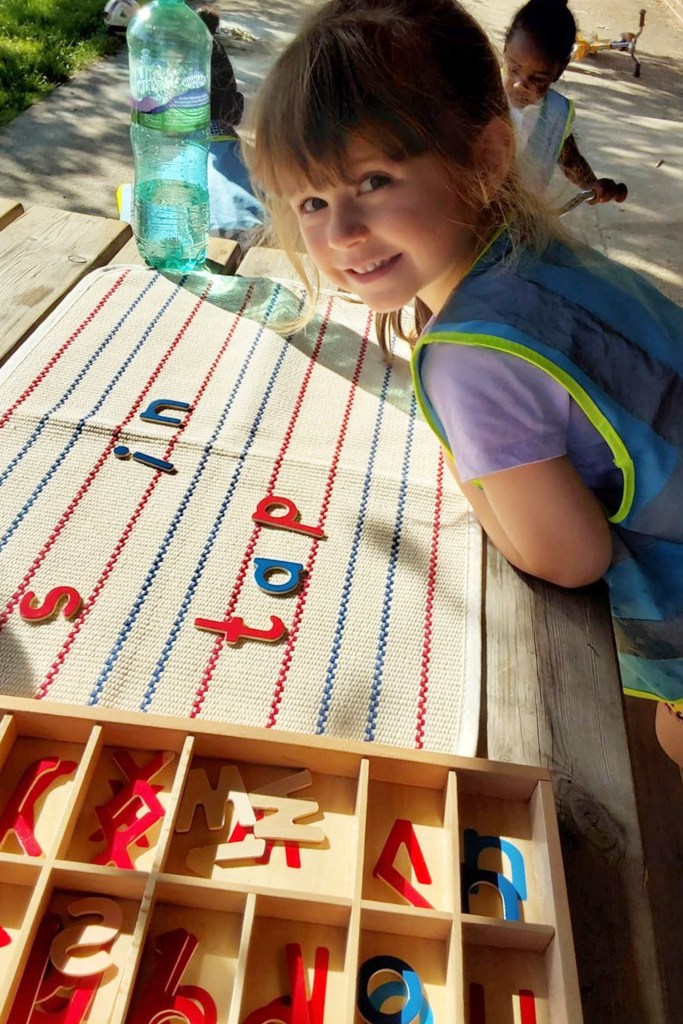
The Moveable Alphabet
This contains 26 wooden letters and is effective in teaching reading, spellings and writing. Children can begin to decode regular and irregular words.
5. Culture
This area ties in beautifully with the EYFS curriculum, Understanding of the World. It includes Geography (continents, land formations, earth layers and the solar system) , Zoology (the classification and physiology of animal), Botany (ecology, classification and physiology of plants) History (timelines and calendars) and Science. You can therefore expect to see flags, puzzle maps, globes and materials from other countries in our nursery.
 The Little Lighthouse Nursery